

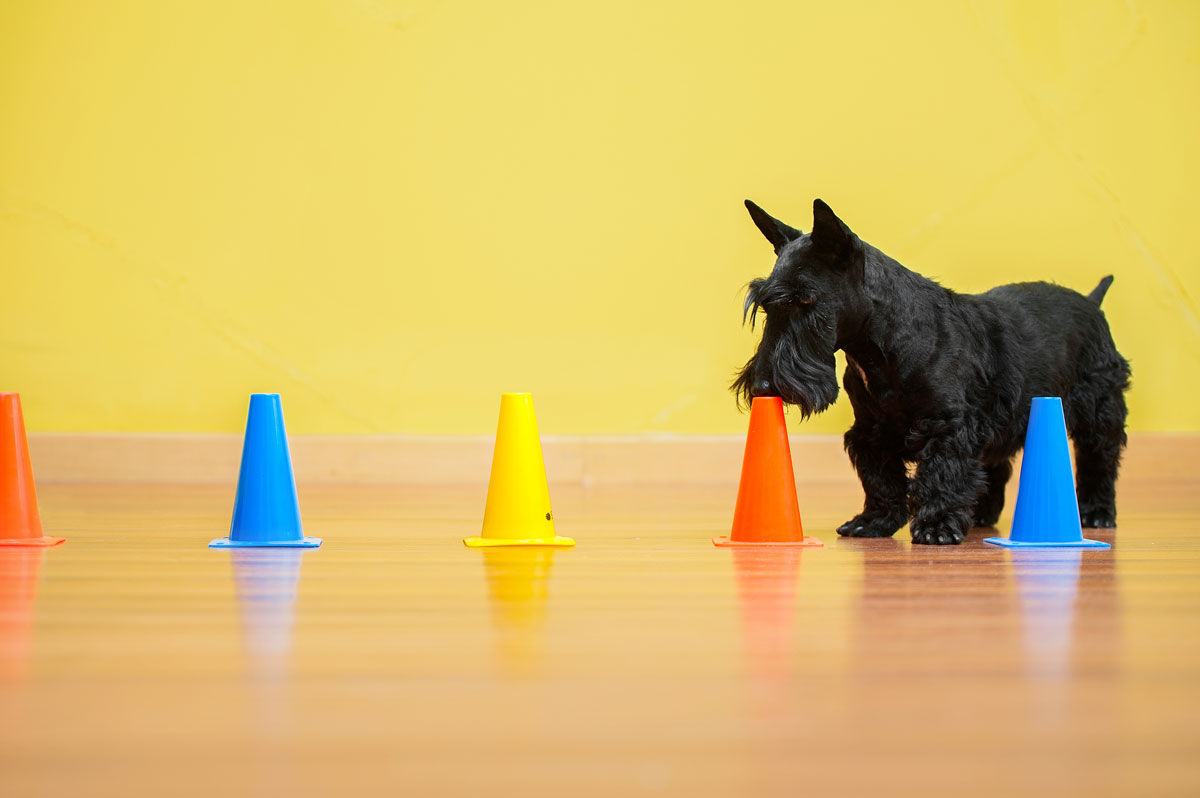
The Dog Sport Where Every Body Can Compete
When Kathy’s one-year-old Labradoodle Ryder was diagnosed with a broken hip that left him with a false joint and a lifelong mandate to participate in only low-activity exercise, she was left wondering how this exceptionally smart, active dog would get enough stimulation.
Then she heard about recreational scent work and its positive mental stimulation and decided to give it a try. From the first session, she knew she’d found the perfect activity.
“It was great because it did exhaust him, both mentally and physically,” she said. “After a competition, he’ll sleep so late the next morning that he’ll forget all about waking me up to be fed.”
Recreational scent work grew out of professional detection-dog training used for police and military dogs, and has increasingly gained popularity over the past 15 years. It began in 2006 when professional dog trainers Ron Gaunt, Amy Herot, and Jill Marie O’Brien developed K9 Nose Work, which allows dogs of all breeds, ages, and abilities to use their natural scent skills to search for hidden odors as a fun enrichment activity. It quickly grew into a competitive sport, with the National Association of Canine Scent Work (NACSW) established in 2009 and now exists in numerous organizations and competition formats.
“Dogs’ noses are thousands of times stronger than human noses,” said Kim Lewis, owner of Lucky Dog Events in New Salem, Mass., where Ryder attends classes. “Investigating with their noses, finding the prize and getting rewarded gives all dogs, and especially anxious or reactive dogs, an outlet and a confidence boost.”
In scent work, dogs are trained to sniff essential oils, usually birch, anise, clove and cypress, in the same way a detection dog would be trained to find gunpowder or drugs, said Lewis, who has been instructing dogs in multiple sports including agility, nose work, obedience, confidence, puppy classes and more for 25 years.
There are multiple types of scent work: container searches, which Ryder does, where dogs sniff out a scent in a box or other closed container; interior searches, to find a scent in a room or building; exterior, where dogs sniff grassy areas or fields for a specific scent, often a pair of antlers; barn hunts, where dogs sniff out rats; and vehicle searches.
Any breed can participate in scent work, and dogs can begin training as puppies. They can typically begin competing between six months and one year old.
Ryder’s mom Kathy, said it’s also been a wonderful bonding experience for the two. They’ve been doing scent work together for more than two years, and Ryder has competed and titled in the sport multiple times, which is another positive aspect, she said, as it’s not just about winning first place.
Titling in the sport means finding all the sniff targets. Any dog in the competition can title, although usually only a small percentage of each group do. And the ones who find them the fastest “win” by placing in the competition.
Kathy and Ryder go for accuracy over speed, but she said he’s also come in first place at some of his competitions, which is a fun bonus.
But by far, the best part about scent work is its inclusivity. “It’s great for both able-bodied dogs and those who can’t be as active, like Ryder,” Kim said. “If you can’t run in an agility ring, it’s a great alternative.”
Even reactive dogs, who are often excluded from dog sports because of their group nature, can safely participate. The NACSW is strict about where trials and competitions can be held. For instance, they can’t have competitions where there might be dog walkers or loose dogs that could distract or frighten dogs in search areas.
Dog parents can choose to keep their dogs on leash, even during indoor competition searches, if they feel more comfortable doing so. Outdoor sniff searches are automatically done on leash, as it’s all about the safety of the dogs.
“That way, dogs are confident they can search and not worry about other dogs. It’s a great option for dogs that don’t like other dogs,” Lewis said.